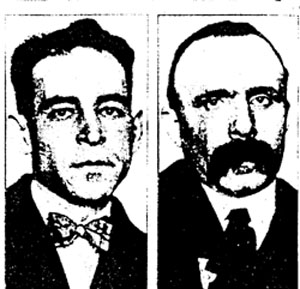
-Anarchism is the stuff of Sacco and Vanzetti, the Braintree Mass. duo falsely tried and executed by electric chair in the 1920s.-
It is a remote and detached ideology; divorced from hope for change it provides an unclear path for change in our society, our consumerism, our architecture, our political structures. In positing a more "honest" view of the superstructure of human society, anarchism and anarchists target the very persons whom they seek to help realize a better future. Anarchism degrades man's current state as an attempt to return him to his natural state, a state perhaps far removed from the Hobbesian nature of the life of man as "short, brutish, nasty..." An anarchist refers to a "capitalist pig" or "corporate stooge", as though debasing his fellow man positions the anarchist as a moral superior. To get someone to change to your way of thinking, you don't first charge the conversation with insults, satisfying as it may be.
When personal anarchism is oriented towards mobilizing the masses; in protest against governance, in barn-storming McDonald's restaurants, in assassinating public figures, in resisting contemporary models of the "good life", anarchism renders itself useless. Sheer and uncompromising opposition to what is will be met with a counteracting force of either criminalizing suppression or complete apathy (sprinkled with revulsion). Taking to the streets without petitioning is cheap and temporary publicity. Sticking anti-authoritarian necks out at WTO summits changes nothing. Martyrdom in this "cause" falls on largely unsympathetic ears. It is not like the cause of Civil Rights, with direct and easily identifiable results, specific laws to be changed, specific persons to whom one may point and say, "that person and her family, or you, or I, will be more free if I seek to make it that way." Anarchism has the vainglorious mission to liberate us all, even those who do not seek liberation. It is largely a self-serving ideology, which is not necessarily a bad thing, but has the pretense of working towards the greater good.
Resisting and fighting the public will result in the criminalization of anarchists, who have long suffered the fate of Sacco and Vanzetti, immortalized by few, ignored by most, and misunderstood, perhaps, by all.
-After tapping out this post this morning, I came across the story of the McLibel case in England a few years back, involving two "anarchists", Helen Steel and Dave Morris, being sued by McDonald's for libel. The pair had been spreading anti-McDonald's leaflets around London. The ensuing trial, though not favorable in verdict for the two, resulted in a public relations fiasco for Mickey D's. I'm actually really impressed.
Although this post has little to do with architecture, as is the stated intent of Front Porches, it brings up some of my fundamental questions surrounding the ideas of "anarchitecture". I think I'm also in some way giving body to my reactions from a very recent trip to New Orleans.
It is a remote and detached ideology; divorced from hope for change it provides an unclear path for change in our society, our consumerism, our architecture, our political structures. In positing a more "honest" view of the superstructure of human society, anarchism and anarchists target the very persons whom they seek to help realize a better future. Anarchism degrades man's current state as an attempt to return him to his natural state, a state perhaps far removed from the Hobbesian nature of the life of man as "short, brutish, nasty..." An anarchist refers to a "capitalist pig" or "corporate stooge", as though debasing his fellow man positions the anarchist as a moral superior. To get someone to change to your way of thinking, you don't first charge the conversation with insults, satisfying as it may be.
When personal anarchism is oriented towards mobilizing the masses; in protest against governance, in barn-storming McDonald's restaurants, in assassinating public figures, in resisting contemporary models of the "good life", anarchism renders itself useless. Sheer and uncompromising opposition to what is will be met with a counteracting force of either criminalizing suppression or complete apathy (sprinkled with revulsion). Taking to the streets without petitioning is cheap and temporary publicity. Sticking anti-authoritarian necks out at WTO summits changes nothing. Martyrdom in this "cause" falls on largely unsympathetic ears. It is not like the cause of Civil Rights, with direct and easily identifiable results, specific laws to be changed, specific persons to whom one may point and say, "that person and her family, or you, or I, will be more free if I seek to make it that way." Anarchism has the vainglorious mission to liberate us all, even those who do not seek liberation. It is largely a self-serving ideology, which is not necessarily a bad thing, but has the pretense of working towards the greater good.
Resisting and fighting the public will result in the criminalization of anarchists, who have long suffered the fate of Sacco and Vanzetti, immortalized by few, ignored by most, and misunderstood, perhaps, by all.
-After tapping out this post this morning, I came across the story of the McLibel case in England a few years back, involving two "anarchists", Helen Steel and Dave Morris, being sued by McDonald's for libel. The pair had been spreading anti-McDonald's leaflets around London. The ensuing trial, though not favorable in verdict for the two, resulted in a public relations fiasco for Mickey D's. I'm actually really impressed.
Although this post has little to do with architecture, as is the stated intent of Front Porches, it brings up some of my fundamental questions surrounding the ideas of "anarchitecture". I think I'm also in some way giving body to my reactions from a very recent trip to New Orleans.


2 comments:
I would like to add to this post, without removing it, that perhaps I spoke too soon, relying on impression (somewhat misinformed) rather than reflection, particular discomfort rather than objective assessment.
After talking with Jackson and reorganizing my thoughts on anarchism, discussing its inherent principles and divorcing them from popular misconception and portrayal, my conclusions on the theory have become more honed. And while I can't categorically deny my most basic reservations, I can only hope to discover further truth in the ideal, peeling back the layers of personal history to uncover some fundamental beauty in pursuing a future not guided by corporate dictates and malicious advertising, war mongering and the perpetuation of society's fear-based response mechanism.
Anarchism, May I be Convinced? The underlying intent of front porches , as intellectual engagement, has perhaps seen its first success, of which I hope there are many.
I view this post as portraying some of our society's popular misconceptions of the anarchist viewpoint. How does a word embraced by so many strike utter fear into the hearts of so many more? At the risk of starting a dialogue with a quite lengthy potential (hopefully not delaying further posting), there are several points which Brian brought up that I would like to touch on.
The main argument presented here portrays anarchists as spiteful individualists looking to resign from society out of sheer repulsion at its present goings-on. To smear such a label on all who simply desire a system devoid of exploitation and hierarchy is the equivalent of saying that all liberals view right-wingers as ignorant racist country bumpkins and all conservatives see lefties as patchouli-doused druggies. Not only is this blanket statement offensive to those being targeted, it also ignores a large part of the population on BOTH sides of the playing field: very few anarchists seek change through insults and violence (obviously, otherwise the movement would be reported on much more often), and few anarchists truly hate all capitalists, as (I would hope) very few capitalists go about their deeds maliciously. The capitalist SYSTEM is what is to be fought, realizing that our society's ingrained obsession with personal success through wealth leads to the exploitation of those who are not "lucky" enough to be involved in the upper echelons of the machine.
That being said, capitalism is not the ONLY target of change through anarchism (although one of the most obvious, given its overwhelming influence on people’s thoughts and actions). “Anarchy" simply translates to "without rulers"... advocating a system of living in which all people are viewed as equals, regardless of sex, race, economic status, nationality, etc, seeking to eliminate the injustices and oppressions too often inherent in hierarchical society. The statement “anarchism and anarchists target the very persons whom they seek to help realize a better future” could not be more wrong: in keeping with non-hierarchical acts, anarchist change works from the ground up. Advocating true grassroots change as opposed to change from the top (such as overthrowing a state – an act simply instituting a new form of hierarchy) is anarchism’s modus operandi. Yes, “in barn-storming McDonald's restaurants, in assassinating public figures,” anarchism does “render itself useless.” But to assume that these are the only solutions which anarchism has to offer implies that it is acceptable to turn a blind eye to what an ideology professes, judging it simply by how a few followers have acted, however irrational or philosophically incongruent these acts were. Are all followers of Islam terrorists? Are all proponents of “Democracy” war-mongers? As shown through history, following the moral code of the State (change through violence and terror) does not bring about positive results for a movement. This process also does not gel with the views of many anarchists, influenced strongly by the pacifist teachings of Daoism and Zen-Buddhism which seek positive transformative growth as opposed to violent deconstruction (see John Clark’s “Master Lao and the Anarchist Prince” @ http://raforum.info/article.php3?id_article=4488&lang=en).
Popular media and culture’s equating of the anarchist with terrorism is one reason why many anarchists prefer to be called “libertarian socialists.” This term is practically synonymous in describing the platform presented by anarchists, avoids the tarnished “anarchist” title, and touches on the history of the movement: “Le Libertaire” (“The Libertarian”) has been the title of anarchist publications in the United States and France dating back to the 1850s, long before the relatively young Libertarian Party formed in the US in the 1970s.
This quest for liberty for EVERYONE in the anarchist movement has been grossly overshadowed by popular misconceptions of its goals. In other words, the media portrayals of the actions of a very small number of extremists (whom many would argue have acted without truly adhering to anarchist principles) have been taken by many to represent the majority of anarchists. Making these assumptions without any further research into the topic – relying solely on the descriptions of a sensationalist media – is at the least naïve, while at the most ignorant, malicious, and inexcusable. Where is the excitement in reporting on a community coming together autonomously to sustain itself on its own means of food production, peacefully resist the effects of racism, xenophobia, and economic oppression, or provide free educational workshops to all, when it is much easier to point to a single angst-fueled individual tossing a brick through a department store window?
As anarchism by definition does not have any leaders, it is not a movement whose many constructive works are destined to be recognized, but a movement seeking to create positive change through involvement of everyone (anyone) at the most basic, direct, hands-on level. The conjecture that anarchism seeks “to liberate us all, even those who do not seek liberation,” is irrelevant, as this condition can be applied to any political/social institution: we are all presently thrust into the hands of a capitalist society, even if we neither seek nor desire this “liberation.” Anarchism, however, not only offers a chance to participate in a liberated system in which our actions do not tread all over the hopes, opportunities, and dreams of others, but does so without forcefully imposing any sort of rule from above.
For more info, check out http://raforum.info/ for some well-done writings or www.anarchistfaq.org for a pretty comprehensive FAQ on anarchism.
Post a Comment